
White Horse Close
 1 / 10
White Horse Close discover
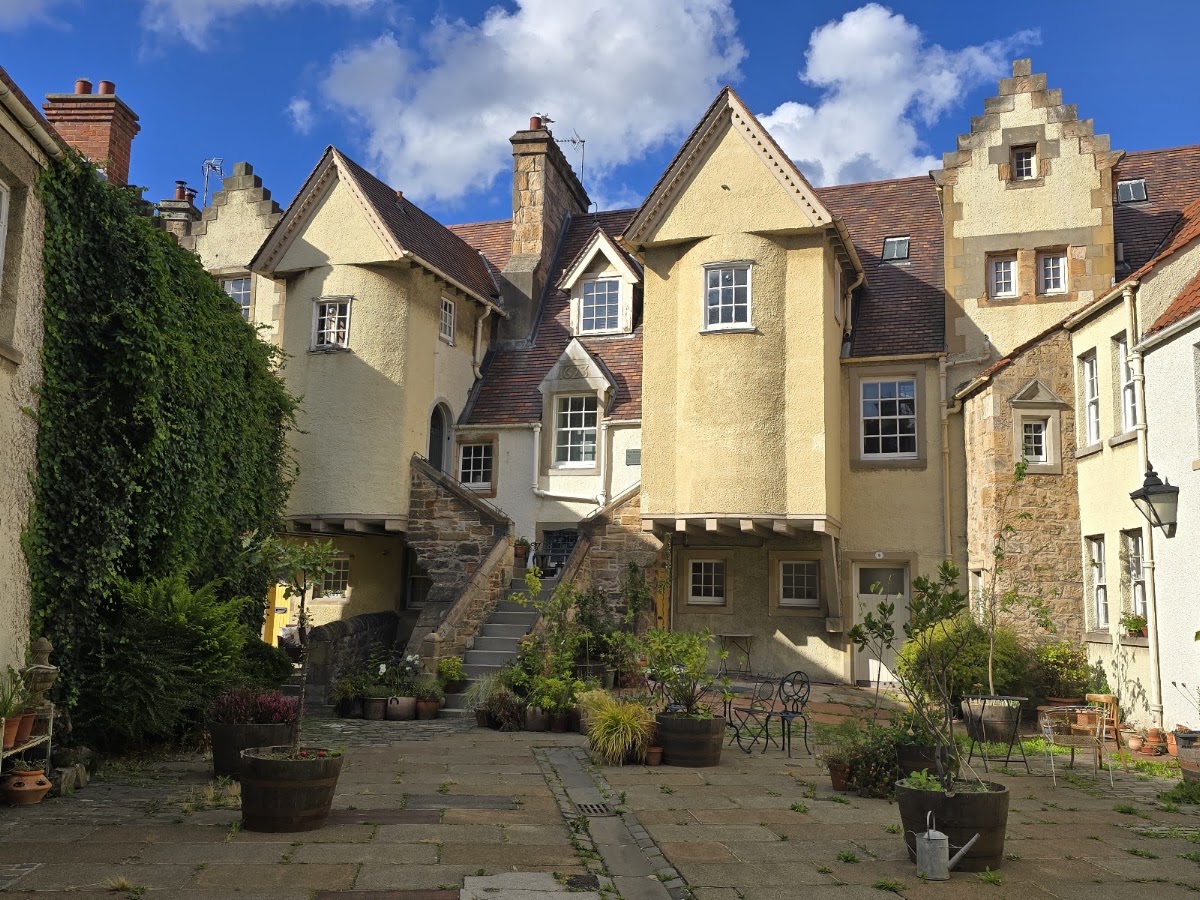
A picturesque residential courtyard off the Canongate with split fore-stairs, projecting gables, and red pantile roofs.
White Horse Close traces its origins back to the 17th century, though its picturesque appearance is largely shaped by later restorations and reconstructions. Listed building records cite works in 1889 as well as by Sir Frank Mears and Partners in 1964–65. The ensemble is Category B listed and described as a Scots Revival group. The datestone "1623" is a prominent feature, but not proof that all present-day building elements have survived unaltered since that year.
The tapering courtyard brings together a striking array of external staircases, gables, and differently rendered or exposed stone facades. Especially notable is the divided open staircase on the north side with the projecting gables above; red pantiles accentuate its distinctive character. Because the close comprises residential homes, photography should remain discreet and not intrude into private stairwells or right up to front doors.
What to Expect
- Split fore-stair
- Projecting gables
- Red pantile roofs
- Enclosed, tapering courtyard
Plan Your Visit
- Origin
- 17th century.
- Restoration
- Reconstructions in 1889 and 1964–65.
- Heritage protection
- Category B.
- Architecture
- Split fore-stair on the north side and 1623 datestone.
- Access
- Check current access notices on site
Tips for Your Visit
- Look for the passageway within the block at 23–33 Canongate.
- Respect the residential setting; do not use stairs or doorways as viewing spots.
- If the gate is closed, do not assume guaranteed 24/7 public access.
Here You’ll Find White Horse Close
1–12 White Horse Close, access via 23–33 Canongate, Edinburgh, Scotland
Rate White Horse Close too
Been there? Then tell the others what you loved and what surprised you.